Good AI starts with a good story
Why most bad AI answers start before the AI writes a word
Remember learning to write stories at school?
We were taught six simple questions:
Who, What, When, Where, Why and How.
Our teachers weren't only teaching us to write. They were teaching us to get an idea across so someone else could actually understand it.
Who was involved? What happened? When and where did it happen? Why did it matter? How did it happen?
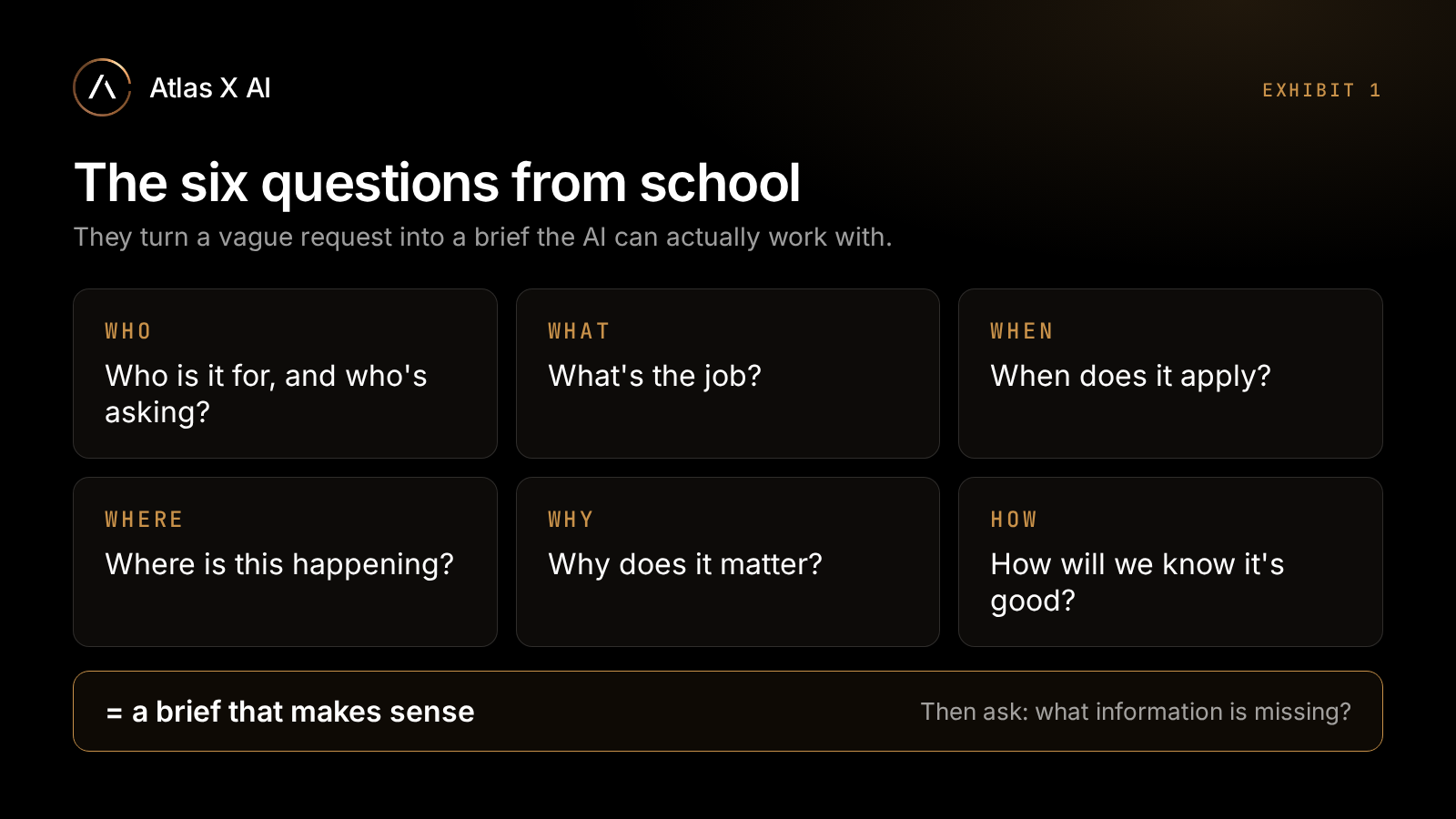
Leave those out and the reader has to fill in the gaps themselves.
Funny enough, I think we've forgotten this lesson when it comes to AI.
We open ChatGPT, Claude or another AI tool, type a question and expect a brilliant answer.
But does the AI know what we're trying to achieve? The circumstances? Why we're asking? What a good result looks like?
And when the answer is terrible, we're quick to blame the AI.
"It hallucinated."
"It just makes things up."
Sometimes it does. Models genuinely get things wrong, and good instructions can't guarantee accuracy.
But what if part of the problem is that we never gave it enough of the right information to begin with?
That question has fascinated me while building my own AI agents at Atlas X AI. The more I work with AI, the more I realise a good result starts long before the model writes its first word.
The brain behind AI
Think of an AI model as an extremely well-read person.
Someone who has studied an enormous amount of writing and learned patterns about language, reasoning, code and how things work.
Now imagine asking that person to walk into your business for the first time and solve a problem without telling them anything about it.
They might have brilliant ideas. But how would they know which ones apply to you?
That's the difference between what a model learned in training and the context you give it.
Language models write their answers by predicting the next piece of text, one token at a time, using the patterns they learned and the information in front of them.
It's a powerful process. But the model doesn't know what happened in your meeting yesterday, which decisions you've made, or what's sitting in your project files.
That's where context comes in. Context is the information that lets the model apply what it knows to your situation.
And sometimes the most important context is something you wouldn't think to include.
What about who YOU are?
Say two people ask AI the same question: "How should I start learning AI?"
One is a software engineer with ten years of programming experience.
The other runs a small business, has never written code and wants to know how AI could help with their daily work.
Same question. Same model. Should they get the same answer?
Of course not.
Their experience, circumstances and goals are part of the context needed to give each of them something useful. Even small details, like being based in Australia, preferring practical examples or having little time to learn, change what a good answer looks like.
Context isn't only about the problem. It's also about the person trying to solve it.
But what about privacy?
There's a good reason people hesitate to give AI more information about themselves.
They don't necessarily want to hand personal details or confidential business information to technology companies. I think that's a perfectly reasonable concern.
The Office of the Australian Information Commissioner recommends, as best practice, that organisations do not enter personal information, and particularly sensitive information, into publicly available generative AI tools (OAIC guidance).
But understanding someone's circumstances doesn't mean knowing their whole identity.
"I run a small business in Australia and I'm new to coding" might be all the model needs. It doesn't need your home address, private messages or customer records to explain programming concepts.
This is a real tension, and I don't think anyone has fully solved it yet. AI gets more useful the more it understands, and people rightly want control over what it knows. It's one of the main reasons I'm building a governed context system at Atlas X AI: one where the AI is given what the task needs, and nothing it doesn't.
The goal is relevant context, not unlimited access.
Why a longer chat isn't always a better one
Here's something many people don't realise about AI conversations.
In most chat tools, every new message is answered using the conversation so far: your earlier messages, the instructions and any tool results. So as a chat grows, the system processes more and more information each time. Some of it may be cached, summarised or dropped along the way.
Cost isn't the only problem.
Imagine spending an hour on marketing ideas, then asking the same chat to troubleshoot your computer. The earlier discussion might help, or it might drag in information that has nothing to do with the new job.
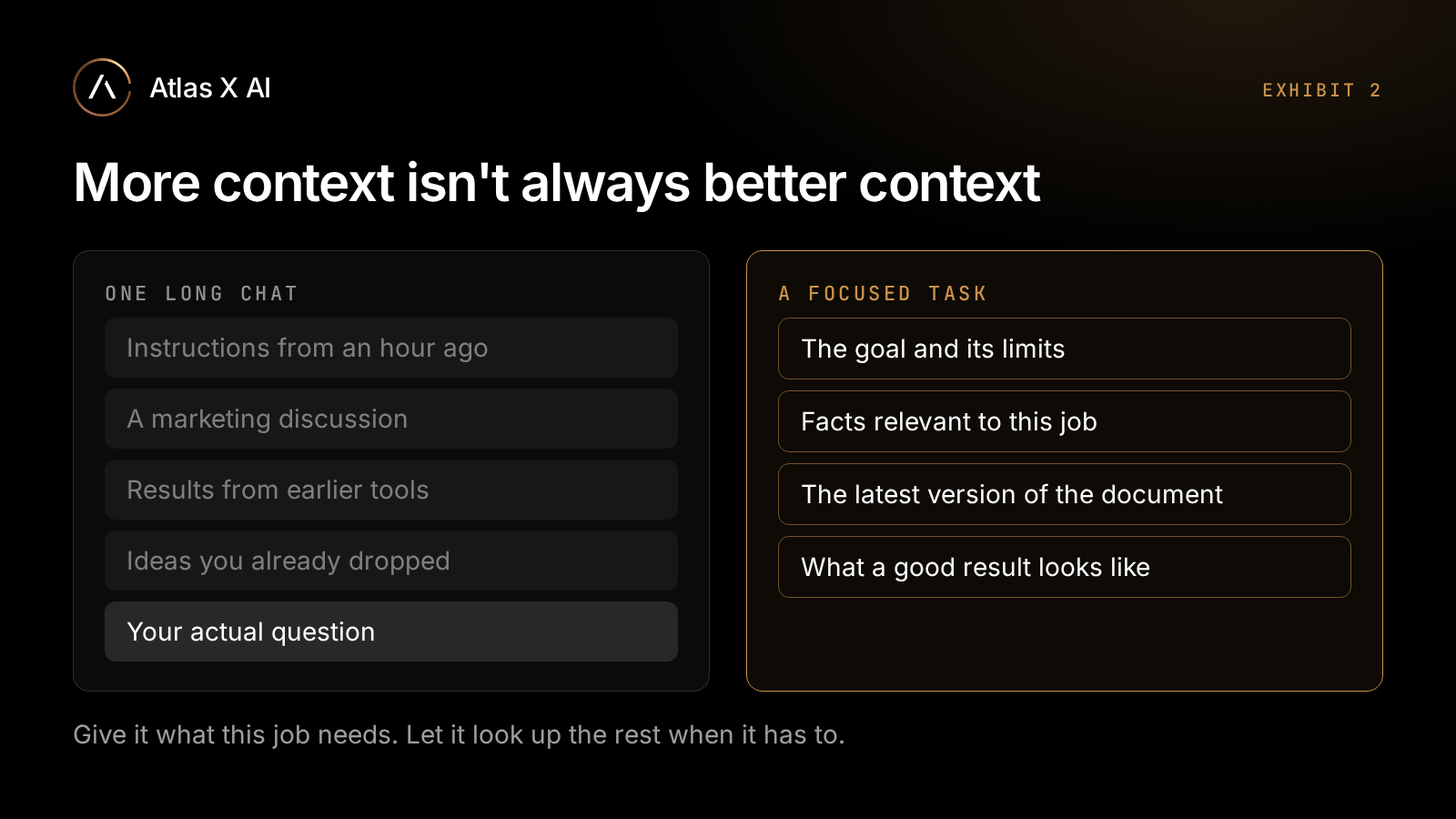
I've seen how big this gets in my own work. In one long-running agent session, we measured the typical amount of context processed per step grow more than fivefold, from about 106,000 tokens to about 542,000. That led me to change how my agents measure and manage their context, and it's work that's still going.
The lesson: a longer conversation doesn't mean the AI understands your task better.
Sometimes a fresh chat, with a clear explanation of what matters, beats carrying on with hours of unrelated history.
Where the right context comes from
So if we don't put everything into one conversation, how does AI get what it needs?
You can give it information directly: your prompt, uploaded documents, project instructions or saved preferences.
But AI tools can increasingly fetch information when they need it, from your calendar, email, Google Drive, business software or project documents.
Connectors are what make that possible. They give a supported AI tool permission to look things up in those systems.
Instead of copying your appointments into a chat, a calendar connector can let the AI pull the relevant events when you ask it to plan your week. A document connector can fetch the latest version of a brief, rather than relying on an old copy pasted in last month.
Connectors aren't automatically private or safe. You still need to understand the provider's data practices, the permissions you grant and what can be reached. Australia's cyber security agency, the ASD, gives small businesses the same advice in its October 2026 guidance: only give an AI agent the minimum access it needs for its task (ASD guidance).
But the principle is powerful. AI doesn't need to carry your whole world into every conversation. It needs a way to find the right information when the task calls for it.
The model isn't the whole system
So far we've covered the model and the information it receives.
But what happens when AI needs to do more than write an answer? Search the web, read a document, check some code, or confirm that an action worked?
That brings in another part of modern AI: the agent harness.
Think of the model as the brain, the context as what it knows about your task, and the tools as what it can use. The harness is the software that brings them together. It decides what the model can reach, which actions are allowed, what comes back, and when the job should stop. The ASD made exactly this distinction in its September 2026 advisory on agentic AI harnesses (ASD advisory).
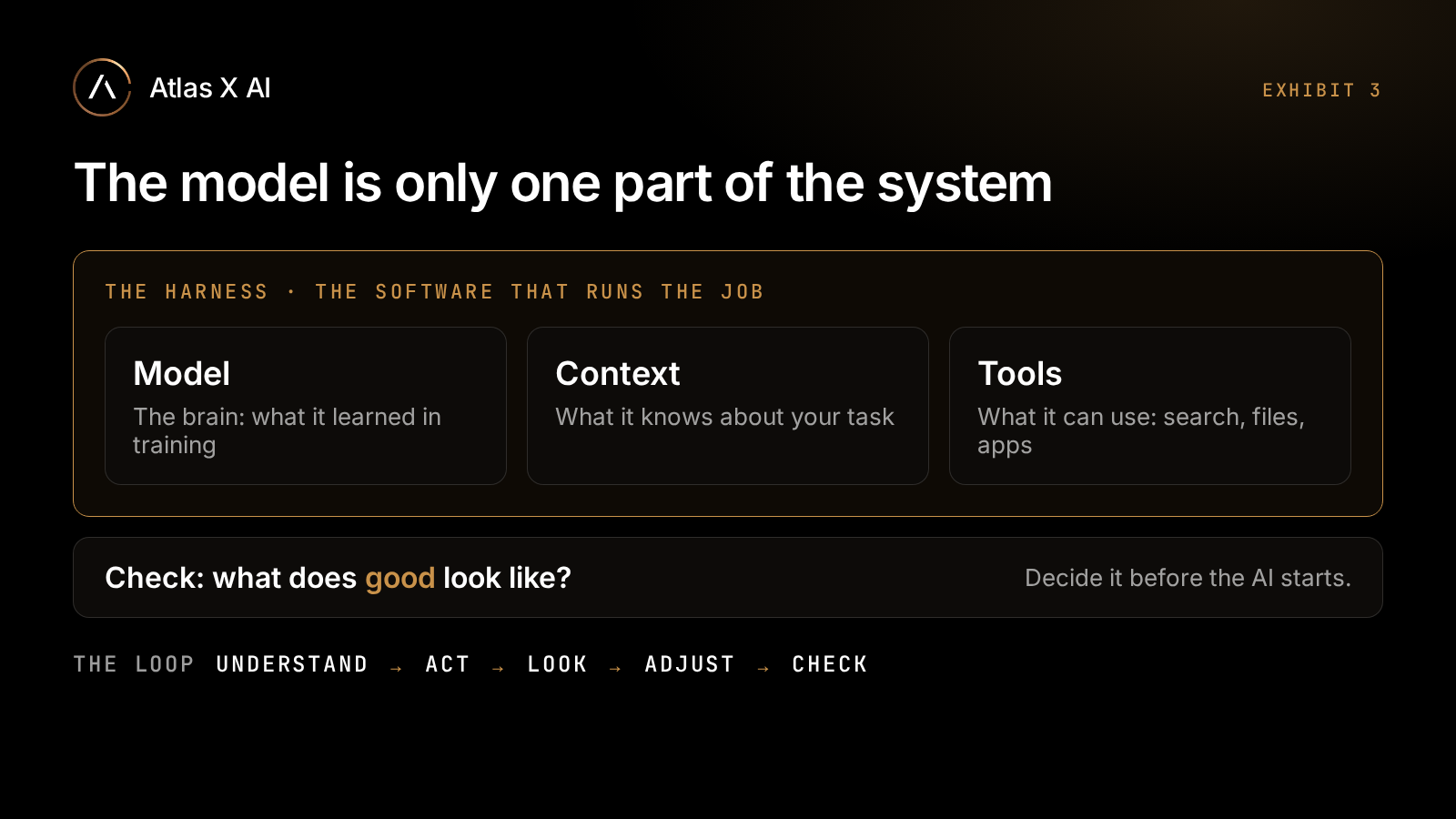
An agent works in a loop: understand the task, decide the next step, use a tool, look at what happened, adjust, and repeat until the job is done or it needs to stop.
Research is starting to show how much the system around the model matters. A July 2026 study, Better Harnesses, Smaller Models, tested seven business tasks. By adapting the instructions, tools and loop around smaller models, the best smaller-model setup reached 89.7% of a much larger model's performance at about 4% of the cost (arXiv paper).
That doesn't mean "always pick the small model". It means don't judge the brain without looking at the system around it.
What does GOOD look like?
There's one more part I think is essential.
If we haven't defined what a successful result looks like, how can we tell whether the AI achieved it?
This is where evaluations, or evals, come in. It's something I've learned a great deal about from Nufar Gaspar's teaching on agentic workflows (nufargaspar.com): give an agent a finish line it can check before you expect it to work on its own.
Getting AI to produce an answer is one thing. Knowing whether that answer solved your problem is another.
How people actually use AI
Google's ATLAS study (no relation to us, funny that), published in July 2026, looked at 15 million de-identified interactions with its AI tools (Google write-up). At work, the vast majority were collaborative: coming up with ideas, planning, finding information and learning. Fully handing a task over was uncommon. And in a typical job, people used AI for only about 21% of their tasks (measured against US occupations).
In other words, most of us are working with AI, not handing work over to it. That makes what we bring to the conversation just as important as the model.
Try this before your next AI task
Before you ask, write six short answers:
- Who is this for, and who am I?
- What is the job?
- When and where does it apply?
- Why does it matter?
- How will I know the result is good?
- What should it NOT be given?
Then ask the AI what information is missing, instead of asking it to guess.
AI doesn't need to know everything about your world. It needs enough of the right information to do the job, and a way to check the result.
I'm curious what you've found. Have you ever got a dramatically better answer just by explaining the problem properly?
Hayden
Founder, Atlas X AI, Perth WA
Further reading
- Google, Understanding the AI economy (ATLAS study, July 2026)
- Australian Signals Directorate, Agentic AI harnesses (September 2026)
- Australian Signals Directorate, Using AI securely in your business (October 2026)
- OAIC, Privacy and the use of commercially available AI products
- Better Harnesses, Smaller Models (arXiv, July 2026)
- Anthropic, Effective context engineering for AI agents
- Nufar Gaspar
Want AI to be more useful in your business? Book a free 30-minute call with me.
Weekly AI Tips for Australian Businesses
Practical AI insights you can implement today. No fluff, just actionable advice.